You went in for a physical, or maybe a DEXA scan, and your doctor said something like: you need to start lifting weights.
It is good advice. It is also, for a lot of women, completely unhelpful on its own. Lifting where? How heavy? Does the walking you already do count? And if you have spent the last decade in Pilates classes because your knees do not love the gym, does any of that protect your bones?
This is a guide to what weight-bearing exercises for bone strength actually are, why the conversation changes around 40, and what the research says about how much load your skeleton needs. In what follows, we will help you understand where a Lagree class fits and where it does not if you are trying to build bone strength.
Table of Contents
- What Counts as a Weight-Bearing Exercise for Bone Strength?
- Why Bone Density Changes for Women After 40
- Do You Have to Lift Heavy Weights to Build Bone?
- How Often Should You Do Bone Strengthening Exercises?
- Can Lagree Support Bone Strength?
- What TIGHT Structural Strength Was Built to Do
- Questions to Ask Before You Start
- Frequently Asked Questions
What Counts as a Weight-Bearing Exercise for Bone Strength?
A weight-bearing exercise is any activity where you are upright, and your skeleton is supporting your body against gravity. Walking counts. Stair climbing counts. Dancing counts.
The Bone Health and Osteoporosis Foundation draws a useful line between two categories. Weight-bearing activity keeps you upright against gravity. Muscle-strengthening activity, sometimes called resistance work, moves your body or an external load against resistance. Both signal bone to adapt, and most women benefit from doing both rather than choosing one.
Weight-bearing vs. muscle-strengthening: the difference that matters
Think of it this way. Weight-bearing work loads the bones that are carrying you: your legs, hips, and lower spine. Resistance work loads whatever bone the working muscle is pulling on, which means it can reach your wrists, arms, and upper back too.
That distinction explains why a walking habit, as valuable as it is, leaves gaps. Your hip fracture risk and your wrist fracture risk are not addressed by the same movement.
Why swimming and cycling do not build bone
Swimming and cycling are excellent for your heart, your lungs, and your mood. They are not bone-building exercises. In the pool, the water carries you. On the bike, the frame carries you. Your skeleton never has to answer for your body weight.
This is the piece that surprises women most often. You can be genuinely fit, train consistently for years, and still not have given your bones a reason to hold their density.
Why Bone Density Changes for Women After 40
Bone is living tissue. It is broken down and rebuilt continuously, and for most of your life those two processes stay roughly balanced.
That balance shifts earlier than most people expect. Harvard Health reports that bone strength begins slipping at an average rate of about 1% per year after age 40, and that a full-body resistance program reaches more of the fracture-prone sites, including the hips, spine, and wrists, than walking or running alone.
The estrogen and bone loss connection
Estrogen helps regulate the cells that break bone down. As levels fall through perimenopause and into menopause, that brake comes off, and the rate of loss accelerates. This is why exercise for bones after menopause gets talked about so much more urgently than it did in your thirties.
It is also why so many women hear about this for the first time in a doctor’s office rather than a gym.
Osteopenia, osteoporosis, and where most women actually sit
Osteopenia means bone density is lower than ideal but has not crossed the osteoporosis threshold. Plenty of women in their forties and fifties land here, and it is often the first concrete signal that something needs to change.
It is not a diagnosis to panic about. It is a diagnosis to act on, and exercise is one of the few interventions with a track record.
Do You Have to Lift Heavy Weights to Build Bone?
Not necessarily. But you do have to load your muscles meaningfully, and “meaningfully” is doing real work in that sentence.
Bone responds to force. The force can come from gravity, from impact, or from a muscle pulling hard on the bone it attaches to. What bone does not respond to is comfort. A workout that never asks anything of your muscles is not going to ask anything of your skeleton either.
What the research says about load and resistance
A 2023 systematic review and network meta-analysis in Frontiers in Physiology, pooling 19 randomized controlled trials and 919 postmenopausal women, found that moderate-intensity resistance training produced significantly better lumbar spine and femoral neck bone mineral density than no training at all. Notably, moderate intensity outperformed both low and high intensity when training three days a week.
That last finding matters for anyone who has been told that only very heavy barbell work counts. Moderate, consistent, well-executed resistance training holds up in the data.
Where low impact exercise for bone health fits in
Low impact and low intensity are not the same thing, and conflating them is how good options get dismissed.
Low impact means your joints are not absorbing repeated shock. Low intensity means your muscles are not working hard. A workout can be one without being the other, and that combination is exactly what many women in their forties and fifties are looking for: something demanding enough to change their bodies and gentle enough on their knees, hips, and lower backs that they can keep doing it for years.
How Often Should You Do Bone Strengthening Exercises?
Most major guidance lands in a similar place: aim for around 30 minutes of weight-bearing activity on most days, plus dedicated resistance training two to three times per week.
Frequency, intensity, and the three-day threshold
The meta-analysis above found three sessions per week of moderate-intensity resistance work outperformed two for lumbar spine density. That is a useful target, though two sessions is meaningfully better than none, and starting with two is a perfectly reasonable on-ramp.
For most women, three focused sessions a week is roughly three hours of studio time. That is the honest commitment, and knowing it upfront tends to make people more likely to stick with it rather than less.
What consistency looks like in a real week
Here is a realistic structure:
- Three to four resistance-focused sessions on non-consecutive days
- Daily walking, ideally at a brisk pace, on the days in between
- One session that prioritizes mobility and recovery
- Rest, actually taken, not skipped
If your schedule cannot hold four sessions right now, build around three and add the fourth when it fits. Our class packs and membership options are structured for both patterns, so the commitment level can follow your calendar instead of fighting it.
Can Lagree Support Bone Strength?
Yes, with an honest caveat we will get to in a moment.
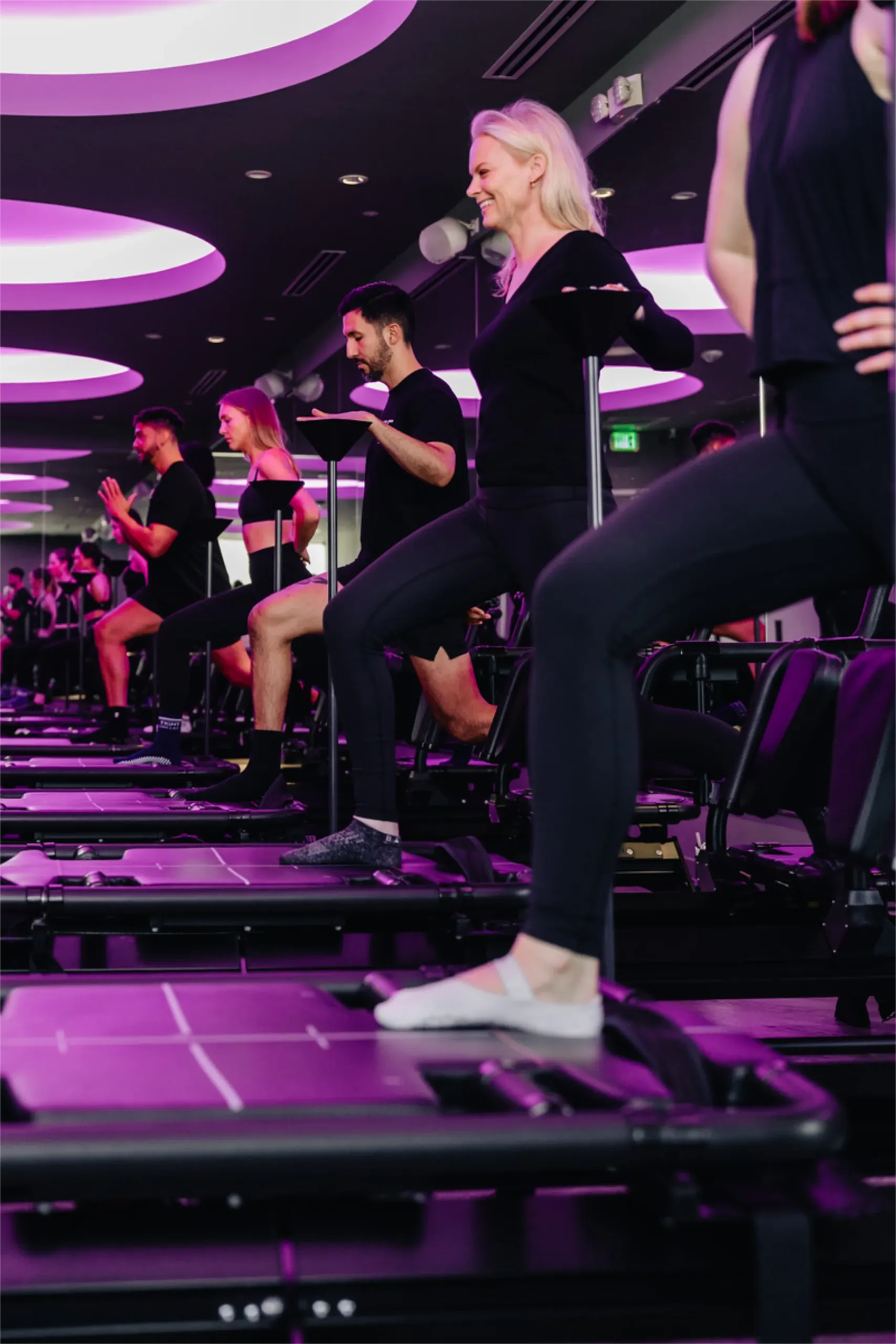
The Lagree Method is performed on a Megaformer, a spring-loaded machine that produces variable and isometric resistance. Movements are slow and controlled, rest is minimal, and muscles stay under tension far longer than in a conventional set-and-rest format.
Time under tension, spring resistance, and skeletal load
When a muscle contracts hard against resistance, it pulls on the bone it attaches to. Sustain that pull through a long, controlled hold, and you have created exactly the kind of mechanical signal bone responds to. Many Lagree positions are also weight-bearing in the literal sense, with your body supported through your own hands, feet, or knees rather than fully reclined.
The appeal for a lot of women is the combination: real resistance training for bone density without the joint impact of jumping or the intimidation of a barbell rack.
Where Lagree helps and where it does not replace medical guidance
Lagree is not a treatment for osteoporosis. If you have already been diagnosed with low bone mass, some positions, particularly deep forward flexion of the spine, as in a kneeling crunch, may not be appropriate for you. The Bone Health and Osteoporosis Foundation flags this movement specifically.
If you have osteoporosis, let your trainer know before class, and they can help with modifications if they have any spinal flexion programmed.
What TIGHT Structural Strength Was Built to Do
TIGHT Structural Strength exists because of a pattern we kept noticing. More and more clients were walking in and saying some version of the same thing: my doctor told me I need to lift weights, and I do not want to.
So, we built a Lagree class to give you the benefits of weight lifting for bone health, without the need to lift weights. Slow tempo, supported setup, full-body integration
Structural Strength is a full-body class built around slow, controlled movement and extended time under tension. The setup is slightly more supported than our signature format, which lets you move with greater precision and stay in each exercise longer. The intent is to stimulate bone growth, build lean muscle, and support joint stability, and the sequencing is written specifically toward that.
You can see it alongside our other formats on the full class descriptions page.
Who this class is for and who should start elsewhere
Structural Strength is suitable for all ages, including women who have never done Lagree; however, it is not suitable for expecting or postpartum clients, who can find a great workout in our LIGHT class options. Our instructors include a physical therapist and an ER nurse, and two master trainers are on staff, so modifications come from people who understand why they matter.
Questions to Ask Before You Start
Talking to your doctor first
If you have osteopenia, osteoporosis, or any history of fracture, ask your doctor two things: which movements you should avoid, and whether there is a load or intensity ceiling they want you to respect. Bring the answers with you.
What to tell your instructor about your body
Arrive at least fifteen minutes early for your first class and tell your instructor about any injury, surgery, or diagnosis. It is not oversharing. It changes the spring setting they put you on and the modifications they offer. It is also worth reading the cancellation window and studio policies before you book so nothing catches you off guard.
Bringing It Together
Bone responds to load, and load is something you can control. Weight-bearing exercises for bone strength do not require a barbell, a gym membership you dread using, or a workout that leaves your joints aching. They require enough resistance to matter and enough consistency to add up, ideally two to three times a week alongside daily movement.
If you have been told to start lifting and have not found a version of it you actually want to do, come try ours. Book a Structural Strength class at TIGHT Dallas, or start with our two-week unlimited intro pass and use promo code TIGHT to cover taxes and fees on your first payment. We are at 6401 Hillcrest Avenue, Suite 202. Frequently Asked Questions
What are the best weight-bearing exercises for bone strength?
The most effective options combine upright, gravity-loaded movement with resistance work. Squats, lunges, presses, and rows, whether you’re working with weights or spring resistance, cover the muscle-strengthening side and, with the right spring load and pace, can also strengthen your bones.
Can you increase bone density after 40?
Bone loss after 40 can be slowed, and in some cases density can improve. Research on postmenopausal women has shown measurable gains in lumbar spine and femoral neck bone mineral density from consistent resistance training. Results depend on intensity, frequency, and how long you stick with it.
Is Pilates a weight-bearing exercise?
Some Pilates positions are weight-bearing, and some are not. Standing and quadruped positions load the skeleton; supine mat work generally does not. The spring resistance in Lagree adds a stronger muscular pull on bone than most mat-based formats, and with specific tempo and spring choices, Lagree can offer real bone health benefits that mat Pilates and yoga simply cannot. How long does it take to see results from bone strengthening exercises?
Bone remodels slowly. Most clinical studies measure change at six months or more, so this is not a fast-feedback pursuit. Strength, balance, and everyday capability improve much sooner, often within four to six weeks, which is usually what keeps people going.
Is low-impact exercise for bone health enough on its own?
It depends on the intensity. Low-impact exercise that still loads your muscles hard, such as spring-resisted or weighted work, can absolutely contribute to bone health for women. Low-impact activity that never challenges your muscles, like swimming or cycling, does not provide the skeletal loading bones need.
Do I need my doctor’s clearance before starting?
If you have been diagnosed with osteopenia or osteoporosis, have a fracture history, or are managing any joint or spine condition, yes. Ask specifically about forward-bending positions, which carry added spinal risk when bone mass is low, and then share that guidance with your instructor.