You have tried the treadmill. You have done the squats. You have spent months in traditional fitness classes, and somehow those same stubborn spots, your deep core, your glutes, your inner thighs, your arms, keep showing up and refusing to change.
Here is what most workouts miss: they do not spend enough time making your muscles work. They load a movement, you power through it fast, and your body compensates with the muscles it already knows how to use. The trouble zones stay quiet.
The Lagree method fixes this. Built around the concept of time under tension, Lagree exercises force your slow-twitch muscle fibers to work continuously, reaching deep into the muscles that traditional training skips over. The machine that makes it possible is the MegaPro, and at TIGHT Dallas, it is the only machine in the room.
This post breaks down the best Lagree exercises by trouble zone, what muscles they target, and why the Megaformer workout changes the body in ways that other methods simply do not.
What Makes Lagree Exercises Different From Traditional Pilates
If you have heard of Lagree and assumed it is just a more intense version of Pilates, you are not alone. But the Lagree vs. Pilates comparison only goes so far. The Lagree method was developed by Sebastian Lagree specifically to combine the muscular conditioning of strength training with the low-impact profile of Pilates, using a proprietary Lagree machine built on the foundation of a reformer, but much more advanced and refined.
The result is a workout that is slower, smoother, harder, and more targeted than classical Pilates. The Science of Slow: Why Time Under Tension Works
The principle behind every Lagree exercise is time under tension, which means keeping a muscle loaded and working for an extended period rather than moving through a rep quickly and releasing.
Research published in the Journal of Strength and Conditioning Research shows that slower tempos during resistance training produce significantly greater muscle activation, particularly in the stabilizing and deep postural muscles that fast movements tend to bypass. When your muscles are under tension for 60 to 180 seconds continuously, they recruit slow-twitch muscle fibers that are responsible for endurance, tone, and long-term metabolic efficiency.
This is why Lagree exercises reach places that HIIT classes and weight rooms often miss.
How the MegaPro Machine Changes the Equation
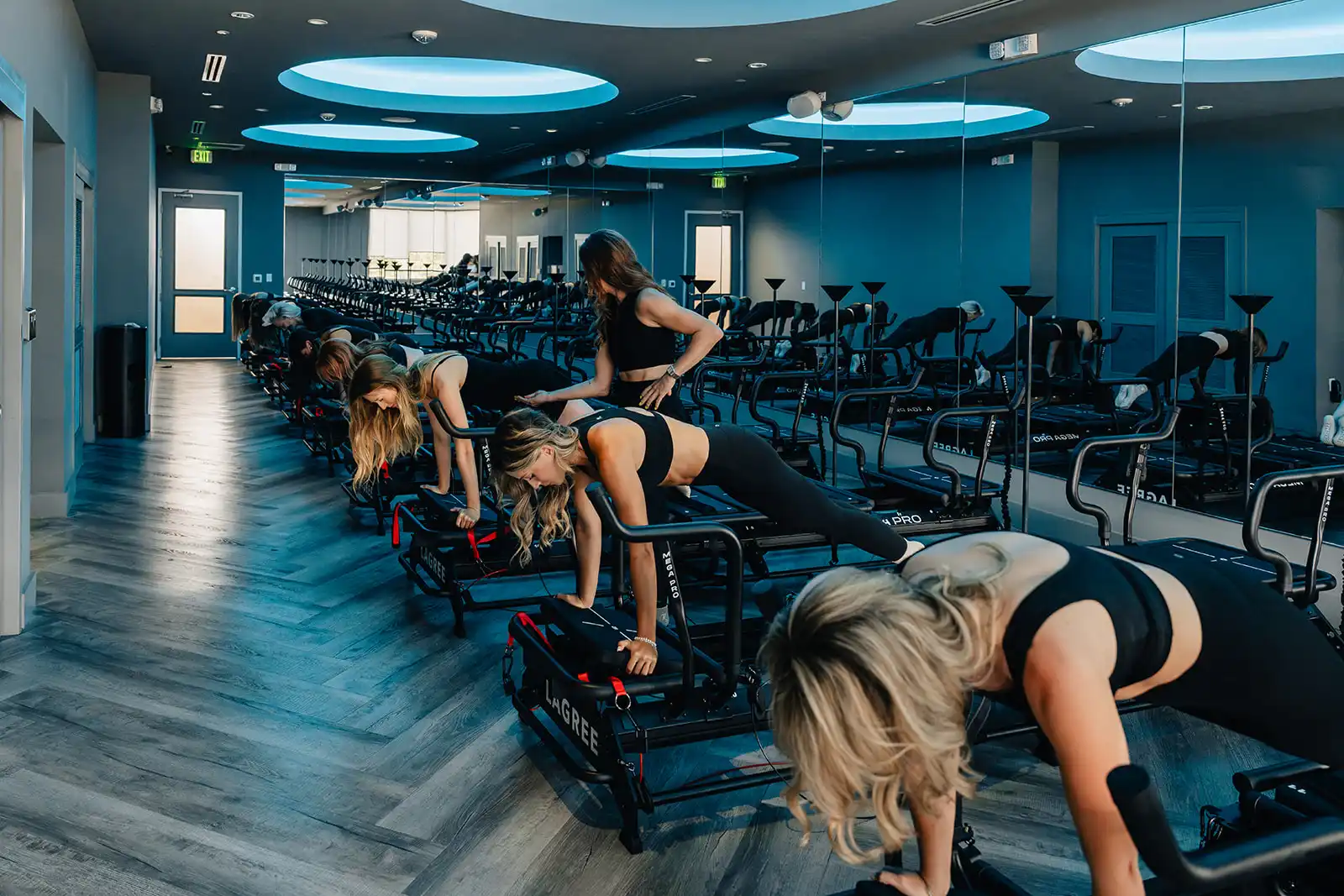
The MegaPro is the latest generation of the Lagree Megaformer, a spring-loaded carriage platform that creates constant, adjustable resistance in every direction. Unlike Classical Pilates, which emphasizes alignment and controlled movement patterns, Lagree takes balance a step further by demanding constant core recruitment through every exercise, even when you are working your legs. The Megaformer’s design keeps your body in a state of controlled instability, which means your core is never just along for the ride.
The springs provide resistance that scales with your effort. Move slowly and with control, and the machine demands more. Rush the movement, and the resistance drops. This built-in feedback loop is what makes megaformer exercises so effective for targeting specific muscle groups with precision.
The Best Lagree Exercises for Your Core (Front, Back, and Deep)
Your core is not just your abs. It includes your deep transverse abdominis, your obliques, your lower back extensors, and the small stabilizing muscles along your spine. Most workouts reach the surface. Lagree exercises go deeper.
Plank to Pike, Bear, and Catfish
Three of the most recognizable megaformer exercises are plank to pike, bear, and catfish, and all three target the core from different angles.
Plank to pike is core-driven from start to finish — with your weight stacked over your hands, your abdominals lift your hips into an inverted ‘V,’ drawing the carriage in, then resist it on the slow return to plank.
Bear also positions you on hands and toes, but here you move between a plank and a tabletop position by bending the knees, which allows for an intense isolation of your center core. So, while in Plank to Pike, your knees stay stable and your hips pike your body into an inverted “V”; in Bear, your hips remain stable, and your knees bend. Both provide an intense core workout.
Wide Catfish targets the obliques and lateral core, which are often the last muscles to respond to conventional ab work.
At TIGHT Dallas, our instructors cue these movements with precise form guidance to ensure you are actually working the intended muscle and not compensating through your lower back or neck.
Why Lagree Targets the Deep Core Most Workouts Miss
The deep core, specifically the transverse abdominis, only activates meaningfully when your spine is stabilized under load for an extended time. Crunches and sit-ups do not get there. Neither does most Pilates mat work.
Because Lagree exercises keep you stabilized on a moving platform for up to 180 seconds per set, your body is forced to recruit the deep core just to hold position. This is what produces the functional core strength clients often describe after a few weeks: not just a flatter stomach, but better posture, less back discomfort, and a more stable base for everything else.
Lagree Exercises That Finally Work Your Glutes and Hamstrings
The posterior chain, meaning your glutes, hamstrings, and hip extensors, is chronically underworked in most people who sit for a living. Standard squats help, but they tend to favor the quads. Lagree exercises flip that balance.
Lunge Variations on the Megaformer
The lunge series on the MegaPro is one of the most effective posterior chain sequences in any fitness format. Front lunge, Reverse lunge, and Curtsy lunge variations all load the glutes and hamstrings under tension for the full duration of each set, with the carriage adding resistance at the bottom of each rep where the glute is most activated.
The key difference from a standard lunge is control. The slow tempo required by the Lagree method means you cannot use momentum to power through the hard part. Your glutes have to do the work the entire way.
Elevator and Escalator for Posterior Chain
Two of the more advanced megaformer exercises for the posterior chain are the Elevator Lunge and the Escalator Lunge. Elevator Lunge loads the hamstrings and glutes in a single leg while also activating the obliques for balance, with one foot balanced on the moving carriage, creating long-duration tension through hip extension. The Escalator Lunge targets the glutes and lower back simultaneously while demanding even greater core stability throughout, with one foot balanced on the stable platform.
Both movements are regularly included in our Lagree classes at TIGHT Dallas and are modified for beginners who are still building posterior chain strength.
Inner Thighs and Hips: The Moves That Get There
Inner thigh and hip adductor work is notoriously difficult to achieve in a functional, sustained way. Most machines isolate these muscles in ways that feel disconnected from how your body actually moves. The megaformer workout addresses this differently, with the help of spring tension.
For starters, Standing Inner Thighs and Standing Outer Thighs can together fully engage the inner and outer thighs in a sustained fashion that also can support greater spinal alignment and core engagement.
Additionally, side-lying Leg Presses on the MegaPro load the outer and inner thighs through lateral movements of the carriage, with resistance adjustable via spring tension. Because the movement is performed slowly and held at peak contraction, both the adductors on the inner thigh and the abductors on the outer hip are under tension simultaneously to maintain balance.
This is the category of Lagree exercises that clients most frequently credit for changing the shape of their legs, because the muscle groups involved are simply not reached by walking, running, or conventional gym machines.
Why These Muscles Are So Hard to Isolate Elsewhere
The inner thigh and hip muscles are designed for stabilization, not primary movement. That means they only engage meaningfully when the body needs to resist unwanted motion, exactly the condition the MegaPro creates with every lateral and rotational movement.
Most traditional workouts never create this condition. The megaformer workout creates it constantly.
Upper Body Trouble Zones: Arms, Shoulders, and Upper Back
Upper body work on the Lagree Megaformer is less about lifting heavy and more about sustained, controlled load. The result is lean arm and shoulder muscles or definition without bulk, and improved posture through upper back strengthening.
Rowing and Pulling Movements on the Carriage
Rowing variations on the MegaPro target the rhomboids, rear deltoids, and mid-trapezius, the muscles between and below your shoulder blades that are responsible for pulling your shoulders back and keeping your posture upright. These are the benefits of Pilates-style training that extend beyond aesthetics into everyday function.
Because these muscles are postural stabilizers, they respond well to the long-time-under-tension format of Lagree exercises. A 90-second rowing set on the carriage does more for upper back tone than three sets of heavy cable rows done quickly.
Triceps and Biceps Work Without the Bulk
Arm work in the Megaformer workout uses the spring resistance of the MegaPro to load the triceps and biceps through a full range of motion at a controlled tempo. The springs provide consistent resistance rather than the variable load of a free weight, which means the muscle is working throughout the movement rather than only at the peak.
For clients concerned about adding bulk, this format is reassuring: the slow tempo and moderate resistance of Lagree exercises build endurance and muscle tone, but not mass.
What Does a Full Lagree Workout Feel Like at TIGHT Dallas?
Understanding individual Lagree exercises is one thing. Understanding what 45 minutes on the MegaPro actually feels like is another.
Class Format and Pacing
A class at TIGHT Dallas moves through a sequence of megaformer exercises with brief transitions between each set. Each movement is held for 60 to 180 seconds. There is no jumping, no impact, and no racing against the clock. The pace is controlled and intentional.
Most clients describe the experience as surprisingly difficult: the slow tempo and continuous tension mean there is no rest mid-set. By the third or fourth exercise, even the most experienced gym-goers are feeling muscles they did not know they had.
What to Expect Your First Time
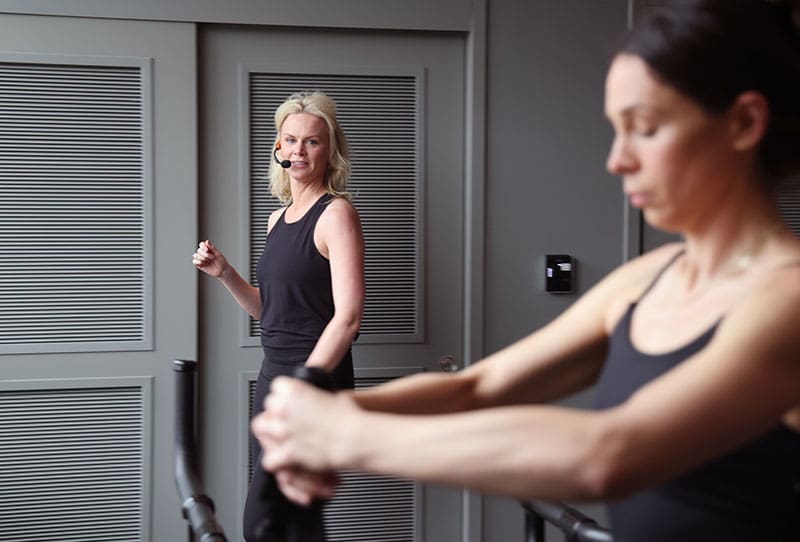
If you are new to Lagree, expect a learning curve on the machine mechanics. Our TIGHT Dallas instructors guide every class with form cues and modifications so that first-timers can find the movement safely. You will not be expected to keep up with a veteran; you will be expected to move slowly and with intention.
Most clients leave their first class feeling worked in a hard way to describe: tired but not wrecked, challenged but not defeated. Check our studio FAQs if you have questions about what to bring or what to wear.
How Often Should You Do Lagree Exercises to See Results?
This is one of the most common questions we hear, and the answer is simpler than most people expect.
Beginner Schedule Recommendation
For clients new to the Lagree method, two to three classes per week are the ideal starting point. The slow-twitch muscle fibers targeted by megaformer exercises need recovery time, especially in the first few weeks when your nervous system is learning to recruit them efficiently.
Three classes per week over four to six weeks is typically where clients begin noticing consistent changes: more definition in the core and legs, improved posture, and a more stable base for other activities.
Why Consistency on the Megaformer Outperforms Volume
One of the distinctive things about the Lagree method is that more is not always better. Because each session fully loads the targeted muscles, adding a sixth or seventh class per week in the early stages tends to extend recovery time rather than accelerate results.
Consistency at three to five sessions per week, sustained over eight to twelve weeks, produces more visible change than seven classes a week for three weeks followed by burnout. This is the class package philosophy we build at TIGHT Dallas: sustainable frequency over aggressive volume.
Your Trouble Zones Are Not the Problem. Your Method Is.
The reason trouble zones persist is not a lack of effort. It is a lack of the right stimulus: sustained, targeted tension in the specific muscles that conventional training skips.
Lagree exercises on the MegaPro deliver exactly that. Whether it is your deep core, your glutes, your inner thighs, or your arms, the megaformer workout creates the conditions your muscles need to actually respond.
If you are ready to stop wondering why certain areas never change, we are ready to show you why they will.
Book your first class at TIGHT Dallas and find out what 50 minutes on the MegaPro actually feels like.
Frequently Asked Questions
What muscles do Lagree exercises target?
Lagree exercises target the full body with an emphasis on the deep core, glutes, hamstrings, inner and outer thighs, and upper back. The slow time-under-tension format of the Lagree method is specifically designed to reach slow-twitch stabilizing muscles that traditional workouts and standard Pilates mat classes often miss.
How is the Lagree Megaformer different from a Pilates reformer?
The Lagree Megaformer, including the MegaPro used at TIGHT Dallas, is a larger, spring-loaded machine that allows multi-directional movement and greater resistance than a traditional Pilates reformer. While both use spring tension, the Megaformer workout is designed for sustained muscular endurance at a slower tempo, making it more effective for body composition changes and deep-muscle targeting.
How long does it take to see results from Lagree exercises?
Most clients doing three to five megaformer workouts per week begin noticing changes within four to six weeks, particularly in core definition, glute tone, and posture. Results depend on consistency, nutrition, and recovery, but the Lagree method is widely recognized for producing visible changes faster than traditional low-impact training.
Is Lagree good for beginners?
Yes. The Lagree method is low-impact and fully modifiable, making it accessible for beginners even though it is challenging for advanced athletes. At TIGHT Dallas, our instructors offer form cues and spring modifications in every class so new clients can perform each movement safely without sacrificing the workout’s effectiveness.
What should I wear to a Lagree class at TIGHT Dallas?
Grip socks are required for all classes at TIGHT Dallas. (We offer them for sale if you do not have any.) Fitted workout clothes are recommended so instructors can see your form and provide accurate adjustments. Check our studio FAQs for a full breakdown of what to bring to your first class.